The challenge
For a leading Italian insurance provider, the team needed to turn an established product vision, business goals and user needs into a coherent claims workspace. A key question was how a claim handler should find important claim information and move toward reviewing and making a payment.
I facilitated a collaborative sketching session with stakeholders and team members to explore that experience together. The aim was to surface different perspectives early and establish a foundation for the wireframes that would follow.
Preparing a focused scenario
Before the workshop, I selected a scenario and key screens that reflected critical business capabilities and the product vision. The starting point was a claim handler who had logged in and arrived on the homepage.
Teams were asked to explore three connected questions:
- What sections and information should appear on the homepage?
- How should the claim handler access key claim details?
- What should the journey to reviewing and making a payment look like?
This gave everyone a common task grounded in a real workflow, while leaving room for different approaches to the interface.
Sketching together
I introduced the purpose and format of the two-hour session, then organized participants into four teams with a mix of user personas and stakeholder perspectives.
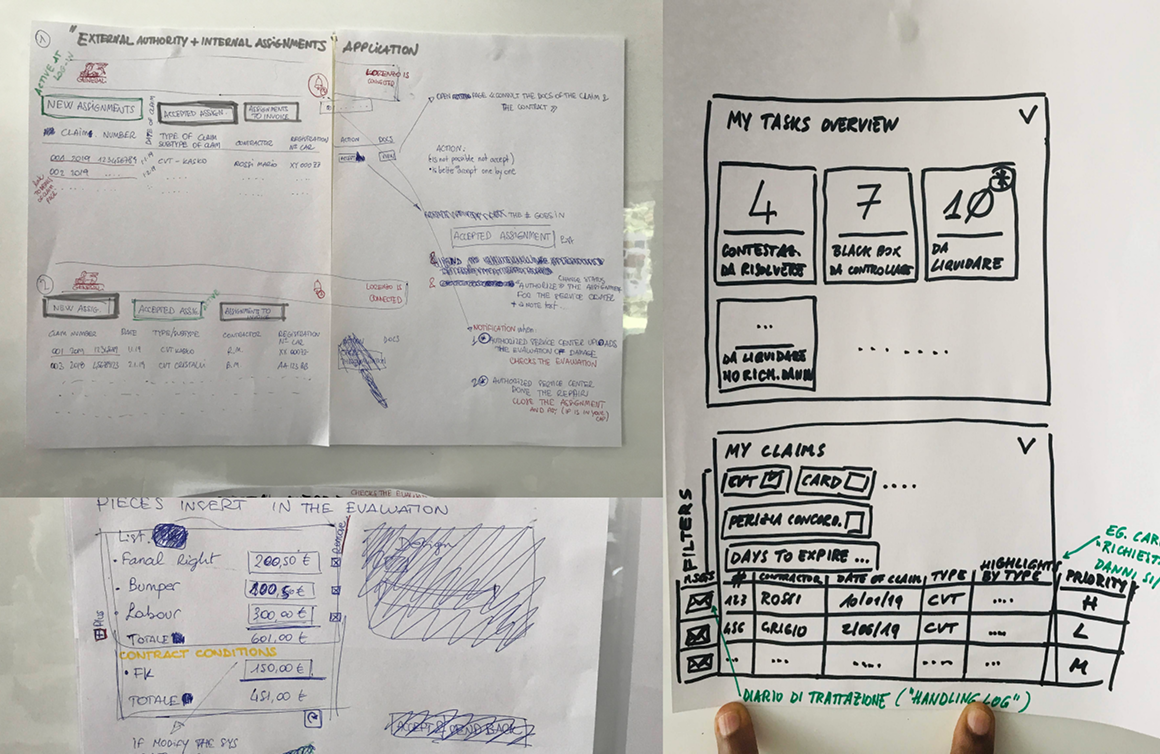
Using paper, pencils, markers and highlighters, teams sketched their interpretations of the scenario. I made clear that the drawings did not need to be polished wireframes. Their purpose was to communicate ideas, expose assumptions and give the group something concrete to discuss.
Each team presented its sketches and explained how a claim handler would move through the proposed experience. These discussions revealed different expectations about the landing page, the information users needed and how the product’s information architecture could take shape.
From shared ideas to design direction
After the session, I gathered the teams’ outputs and reviewed both recurring patterns and distinctive ideas. The synthesis connected what participants had drawn with the constraints and priorities of the product:
- Find common patterns: identify repeated elements that signaled shared expectations and priorities.
- Retain useful differences: highlight distinctive concepts that offered another way to address the scenario.
- Evaluate the ideas: compare concepts against user needs, business goals and technical feasibility to decide what could be carried forward.
- Consolidate the direction: cluster related concepts and develop a combined view of the landing-page layout and functionality.
I translated that consolidated view into my own sketches, shaping the next design direction and providing a starting point for subsequent wireframes.
The outcome
The workshop gave stakeholders an early role in shaping the experience and created shared ownership of the design direction. Comparing ideas in the room helped clarify priorities and supported decisions about the interface before detailed wireframing.
The resulting sketches brought user expectations, business priorities and technical considerations into a common foundation for the claims workspace.