The challenge
At a leading retailer in Italy, department heads placed replenishment orders with distribution centers and suppliers while keeping shelves organized and working to tight ordering deadlines. The process moved between a handheld scanner, stockroom checks and a back-office system.
The study set out to understand how ordering actually happened in the store, including the physical constraints, information gaps and coordination that a review of the existing screens would miss.
Planning the observation
I helped plan in-store observation around department heads’ routines. We first met with the store manager to identify suitable days, then contacted selected department heads to explain the approach and learn when they typically placed orders.
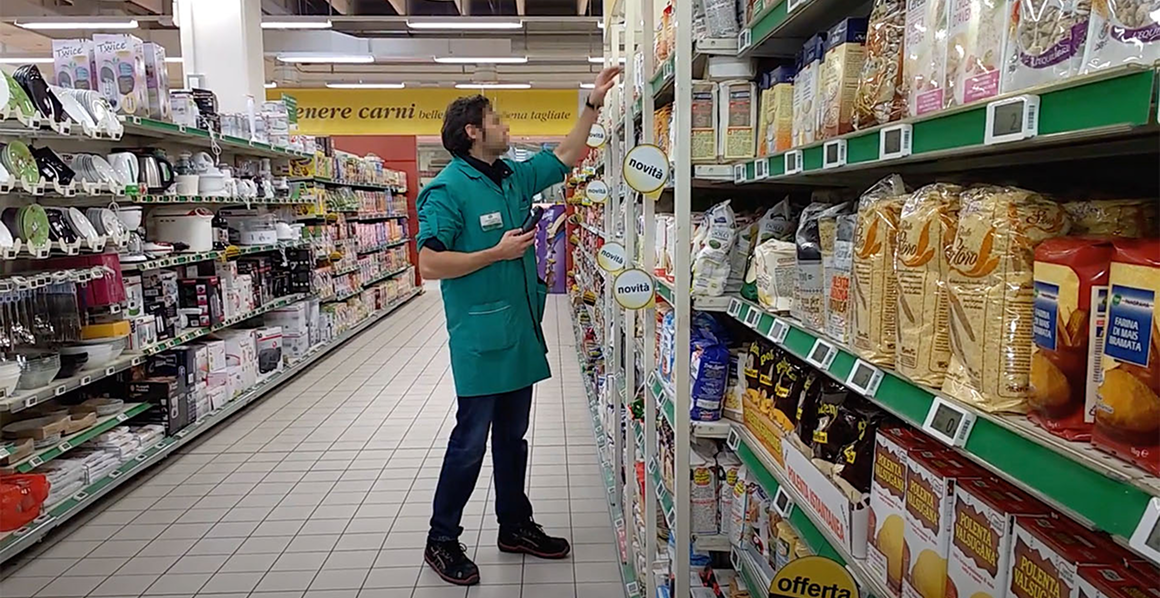
During the session, we shadowed a department head from the moment he picked up the legacy device. Questions were kept brief and discreet so the observation could fit around his work without disrupting the ordering deadline.
Ordering on the shop floor
- Identify and scan: the department head checked shelves for low or depleted stock and scanned product labels to build an order list.
- Verify availability: when unsure how much stock remained, he walked to the stockroom to check, then returned to the shelves and resumed scanning.
- Transfer the list: after completing the scan, he moved the order list to the back-office system.
- Coordinate and submit: store policy required one consolidated order for each distribution center or supplier. Department heads therefore had to merge lists, verify them and complete approvals before submission.
Key decisions from the study
- A device that leaves one hand free. The department head used his other hand to organize shelves while ordering. This made one-handed operation a requirement and ruled out large-screen tablets.
- Responsiveness as a baseline. The legacy device was fast, so the replacement needed to preserve that pace. This informed technical discussions about web versus native implementation and offline support.
- Relevant information at the scan. Reliance on memory and repeated trips to check stock or past orders pointed to a need for stock availability, order history and related product details immediately after scanning.
- Direct ordering with coordination built in. Back-office consolidation created additional work and waiting. The new product introduced ordering from the device with validation and synchronization to support the store’s consolidated ordering process.
The outcome
The study translated everyday behavior into concrete device, interface and ordering requirements. It informed the choice of a one-handed device, established responsiveness as a priority and shaped access to stock information and direct ordering.
Observing the work in context exposed needs that interviews or surveys alone might have missed. It also brought operational constraints into the design process early, grounding decisions in how department heads actually worked.